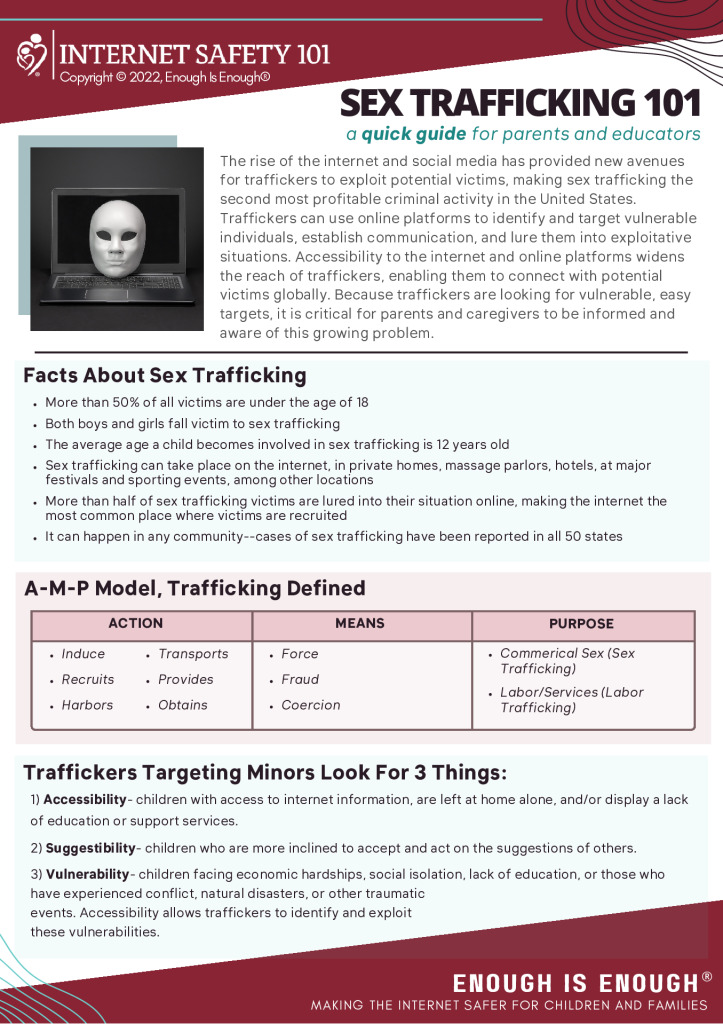
Sex trafficking, particularly involving children, is a grave concern that demands our collective attention. It is reported to be the second most profitable illegal industry — second only to the drug trade. More than 50% of all victims are under the age of 18; both boys and girls fall victim to sex trafficking. In a majority of cases, traffickers use the internet to facilitate, identify and groom victims as it provides direct and easy access, anonymity, and time to manipulate. Online, they can pretend to be anyone, build trust slowly, and exploit kids who seem lonely or vulnerable.
These interactions often go unnoticed because traffickers are skilled at blending into the digital spaces where young people naturally spend time, gradually forming emotional bonds that lower a child’s defenses. By understanding the risks, signs, and preventive measures, parents and caregivers can be better equipped to protect vulnerable children and create a safer online environment for all.
Definitions
Sex Trafficking is the recruitment, harboring, transportation, provision, obtaining, patronizing, or soliciting of a person for the purpose of a commercial sex act in which a commercial sex act is induced by force, fraud, or coercion, or in which the person induced to perform such act has not attained 18 years of age.
Teen Sex Trafficking is exploiting someone under the age of 18 to engage in commercial sex acts. Any commercial sexual activity with a minor, even without force, fraud, or coercion, is considered trafficking.
Commercial Trafficking is any sexual act in exchange for anything of value (it should be noted that it does not have to be an exchange of cash money, it can be anything that holds value such as food, clothing, shelter, etc.)
Demand fuels the commercial sex trade. Traffickers see the potential profits that can be made through their “supply” of sexually trafficked persons – often underaged girls.

Top 10 Myths & Misconceptions about Sex Trafficking
Addressing common myths is crucial in combating sex trafficking and raising awareness. Here are ten myths often associated with sex trafficking in the United States:
Myth #1:
Sex trafficking only happens in foreign countries.
Reality:
Sex trafficking is a significant problem globally, but it also occurs within the United States, affecting American citizens and foreign nationals alike.
Myth #2:
Victims of sex trafficking are always kidnapped or physically forced.
Reality:
While abduction and physical force can occur, traffickers often employ psychological manipulation, coercion, threats, or fraud to control victims and keep them trapped in exploitative situations.
Myth #3:
Only women and girls are victims of sex trafficking.
Reality:
Although females are disproportionately affected, males and transgender individuals are also at risk of being trafficked for sexual exploitation.
Myth #4:
Victims of sex trafficking will always seek help or try to escape.
Reality:
Due to fear, threats against loved ones, trauma bonding, or a lack of viable alternatives, victims may not immediately seek help or attempt to escape their traffickers.
Myth #5:
Sex trafficking only occurs in illegal establishments.
Reality:
Trafficking can take place in various settings, including illegal brothels, escort services, street prostitution, hotel rooms, private homes, or online platforms.
Myth #6:
Sex trafficking victims are always physically identifiable.
Reality:
Victims may not display obvious signs of physical abuse, as traffickers often exert control through psychological manipulation and coercion, making it harder to identify victims in plain sight.
Myth #7:
Only marginalized or vulnerable populations are at risk of sex trafficking.
Reality:
While individuals facing vulnerabilities, such as poverty, homelessness, or a history of abuse, are more susceptible, anyone can be targeted by traffickers, regardless of socioeconomic background.
Myth #8:
Victims of sex trafficking are involved voluntarily or have chosen the lifestyle.
Reality:
Coerced consent and manipulation make it appear as if victims are participating voluntarily, but in reality, they are trapped in exploitative situations against their will.
Myth #9:
Sex trafficking is primarily an urban issue.
Reality:
Trafficking occurs in both urban and rural areas of the United States, as traffickers exploit vulnerabilities and target victims wherever they can find them.
Myth #10:
Victims of sex trafficking can easily escape and reintegrate into society once rescued.
Reality:
Reality: Survivors face numerous challenges, including trauma, fear, stigmatization, lack of resources, and limited support systems, which can make recovery and reintegration a complex and lengthy process.
By debunking these myths and promoting accurate information, we can foster a better understanding of sex trafficking and work towards effective prevention, victim support, and the prosecution of traffickers.

Traffickers look for three (3) things when selecting a potential victim: accessibility, suggestibility, and vulnerability.
Accessibility…
Traffickers gain and maintain access to victims, often through social media and electronic communication, enabling continuous and often unsupervised contact during recruitment and exploitation.
Suggestibility…
Societal influences normalize exploitation. In sex trafficking, the commercial sex industry is falsely glamorized without awareness of its harms, lacking educating regarding the physical, emotion and psychological impact sex work can have on a person.
Vulnerability…
The trafficker leverages personal vulnerabilities, which often intersect with s suggestibility. These vulnerabilities drive victimization and should be central to prevention efforts.
The extent to which individuals can be influenced or manipulated, making them more susceptible to the tactics of traffickers. Societal influences normalize exploitation. For example, in sex trafficking, the commercial sex industry is falsely glamorized without awareness of its harms, lacking educating regarding the physical, emotion and psychological impact sex work can have on a person.
It is essential to understand that these “other at-risk” youth are the children in every school, every neighborhood, every church and youth group and potentially in any home. The dynamics of family have changed over the past few decades, and the traffickers have taken note, exploiting those changes in dynamics to draw young people into a life of servitude through false promises and coercion. In these instances, the traffickers never have to provide their victims with monetary rewards; rather they offer love and affection to a child who is not being fulfilled at home.The extent to which individuals can be influenced or manipulated, making them more susceptible to the tactics of traffickers. Societal influences normalize exploitation. For example, in sex trafficking, the commercial sex industry is falsely glamorized without awareness of its harms, lacking educating regarding the physical, emotion and psychological impact sex work can have on a person.
Traffickers come from all parts of society – every race, gender, and socio-economic group.
Boyfriend/Girlfriend
A common type is an attractive polished man (or woman) in their early 20s, who pretends to be a girlfriend or boyfriend to the intended target.
Gangs
Criminal street gangs also play a significant role in trafficking, sometimes using associates with a less threatening appearance to build the initial relationship.
Employers
Fake employers also lure victims into sex trafficking with promises of modeling or other glamorous careers.
Family
Some victims are trafficked by their own family members or foster parents.
Buyers
These individuals come from all parts of society. Without buyers there would be no demand for sexual services and it would eliminate the scourge of sex trafficking.
The Three Phases of Child Trafficking
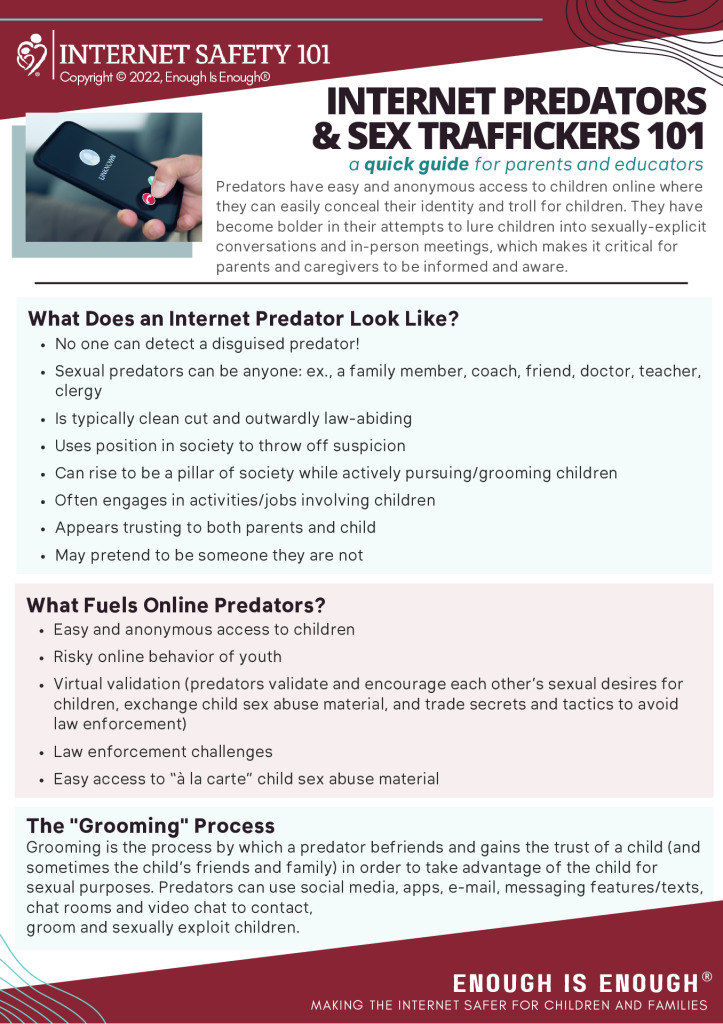
Traffickers rarely abduct victims outright. Instead, they use a slow, calculated process of coercion. Understanding their methods helps us protect our youth and intervene effectively. The following steps used by traffickers is part of the grooming process in which a predator befriends and gains the trust of a child (and sometimes the child’s friends and family) in order to take advantage of the child for sexual purposes.
1. Scouting
Traffickers identify vulnerable youth by learning their interests, struggles, and desires. The most common method of ‘intelligence gathering’ is through social media. As more and more young people share their likes, dislikes, struggles, accomplishments, wants, and needs through the internet, traffickers can lurk in the shadows learning all they need to about our children and waiting for the perfect moment to strike. That moment may be a ‘chance encounter’ at a mall or local teen hangout or an innocent friend request on Facebook, Instagram or some other social media site. Wherever that encounter may occur, the trafficker is prepared to engage the child in a conversation that is sure to capture that youth’s attention.
Whether youth are approached online or in person, traffickers use charm and strategic conversations to gain trust. Their targets often seek love, validation, or financial support, making them susceptible to manipulation.
2. Manipulating
Once engaged, traffickers invest time and effort to build trust. They shower victims with attention, gifts, or promises of love and acceptance, isolating them from family and friends. If it is love and attention that the teen desires, then that is exactly what the trafficker is going to provide. They focus their time manipulating vulnerable teens into believing that they not only care about them and their dreams, but that they ‘accept’ them for who they are. They introduce drugs, alcohol, and distorted perceptions of love to break down moral boundaries, preparing victims for exploitation.
As the teen starts to let their guard down and begins to ‘trust’ the trafficker, the manipulation begins to focus on isolation from parents, family, friends, and church, and even the desensitization of morals and respect for human sexuality. Once the victim is ‘ready’ the trafficker then ‘turns them out’ after which they are trapped, becoming victims both to those looking to profit from their exploitation and those who demand the sexual services of our innocent yout.
3. Trapping
When the victim is fully dependent, the trafficker escalates control through violence, blackmail, addiction, or threats. Victims often feel trapped, unable to escape due to fear, societal judgment, or psychological manipulation.
Methods by which the traffickers can employ to trap victims may include physical violence, sleep or food deprivation, blackmail, or other threats such as summoning law enforcement to arrest the victim if they do not comply with the traffickers’ demands. However, twisted promises of love still exist, often in the form of domestic violence. Victims, feeling that they have no other alternative because of societal views and judgments, threats and fears of the trafficker, or trafficking-induced addictions such as drugs and alcohol, become trapped in a cycle of victimization. Without intervention, their life expectancy is tragically short.
By recognizing these tactics, we can better safeguard our children and support those at risk.
Youth may exhibit one or any combination of the following indicators:
- Change in behavior or mood
- Change in dress or style
- Signs of physical abuse
- Physical changes
- Appears tired and sleepy
- Loss of skin color
- Noticeable change in weight
- Decrease in motivation to do anything
- Increase in secrecy
- Unexplained material possessions
- More sexually promiscuous
- Materialistic / Focus on money
- Sudden changes in peer group or affiliation
- May see indicators of gang involvement
- A sudden and unexplained increase in criminal behavior
- Trafficking victims will often describe their traffickers to others as a “boyfriend/girlfriend”
- An older, dominating/controlling boyfriend/girlfriend
- Frequent travel, local or long distance
- Tattoos that may have unexplained meanings, relate to earning money, or gang affiliation

There are many powerful reasons why sex trafficking victims often don’t (or can’t) seek help:
Fear: Traffickers use violence, threats, and psychological control. Victims may be terrified of what will happen to them or their families if they try to escape.
Shame and stigma: Victims often feel deep shame or guilt about what’s happening to them, even though it’s not their fault. They fear being judged, blamed, or not believed.
Trauma bonding: Sometimes, victims develop emotional ties to their traffickers (similar to Stockholm Syndrome) because of cycles of abuse, manipulation, and occasional kindness.
Isolation: Traffickers often cut victims off from family, friends, and anyone who could help. They may be moved around constantly or hidden away.
Lack of knowledge: Some victims don’t even realize they’re being trafficked — especially if they’ve been manipulated from a young age — and may think this is just “how life is.”
Mistrust of authorities: Victims (especially those from marginalized communities) may fear the police, immigration, or other authorities, worried they’ll be arrested, deported, or punished instead of helped.
Dependency: Many victims rely completely on their traffickers for basic needs — food, shelter, protection — and feel they have no other way to survive.
Language and cultural barriers: If a victim is trafficked in a country where they don’t speak the language, asking for help becomes even more difficult.
Threats against loved ones: Traffickers often threaten to harm victims’ families if they try to escape or tell anyone.
Plan: Specific Guidelines (Applies Online and Offline)
Teach and demonstrate what healthy relationships look like:
Don’t rush into situations with new people.
Instead be cautious and patient and ensure they are who they really say they are.
Always have a friend with you whom you can trust.
Reinforcing the concept of the buddy system at all age levels is important – strength in numbers.
Don’t accept expensive gifts from friends.
Nothing comes for nothing. Also, remind young people that it is important to share what gifts they are receiving. If it is something they would be embarrassed to show their parents, then it is something they should not accept.
If they sound too good to be true, they probably are.
People looking to take advantage of you will say whatever they need to gain your trust. Its important to have open conversations about relationships and situations.
If people try to isolate you from your family or friends, there is a problem.
This might be a hard concept for youth to understand, so take some time and monitor this closely.
Have emergency contacts: teach your child how and/or where to seek help (go to a trusted adult, parent, law enforcement, friend) if a threat arises.
Prevent: Rules ‘N Tools:
THE TEN "Rules ‘N Tools®" FOR CHILD ONLINE SAFETY
Offensive and defensive strategies designed to protect the innocence and safety of children in the digital world.
Implementing both Safety "Rules" and Software "Tools" on all digital devices, online platforms and services used by your child will help to ensure a safer online experience for them, and peace of mind for you. One without the other is ineffective.
"Rules" A Parent’s Offensive Strategy (Non-technical measures)
- Communicate often about online privacy and safety with your child:
- Talk regularly about online activities and stay engaged and involved; build an atmosphere of trust early on.
- Encourage them to think before they post and avoid sharing personally identifiable information (PII) including date of birth, address, full name, school, or other information that can be used to identify and track down a child.
- Instruct them to never send or share explicit images or messages.
- Teach them to avoid meeting in person with someone they only met online because they cannot recognize a disguised predator.
- Direct them to use safe search engines and cybersecurity protections.
- Require parental permission before using third-party apps as many access private information and profiles.
- Warn then about the very real dangers about online predators, traffickers and grooming tactics. Recognize red flags and avoid anyone who attempts to move conversations to unmonitored platforms, private spaces, text and email.
- Use privacy settings on all social media and gaming platforms and block strangers.
- Instruct them to report any inappropriate or threatening messages or requests to social media or gaming platforms, or to authorities if necessary. Tell a parent immediately.
- Supervise your child’s online activities:
- Ensure your child feels safe discussing anything they encounter without fear of parent overreaction. Be a trusted adult. Remind them that no conversation is off limits.
- Consider delaying access to internet-enabled devices until you are certain your child can demonstrate responsible digital habits and the maturity to use and manage technology appropriately.
- Approve all apps, games and platforms your child uses.
- Friend/follow your child’s accounts and know their usernames, passwords and login details on all devices.
- Monitor posts, photos/videos, browser history, messaging and location sharing settings.
- Teach your child digital etiquette:
- Practice the Golden Rule: “Do unto others as you would have them do unto you.”
- Avoid harmful bullying, gossip or hurtful posts; there are no “take backs”.
- Respect others’ privacy and avoid sharing embarrassing content.
- If you see something, say something. If you believe someone you know is in harm's way, tell a trusted adult.
- Teach your child responsible device and technology use:
- Follow family technology rules at home and away. Maintain full transparency about texts, messages and apps, avoid “hiding” online activities.
- Create online accounts and adjust privacy settings/parental controls only with parent/guardian permission.
- Share physical location with parent/guardian permission, and keep location services active only for direct family.
- Care for and maintain phones and devices, keeping them charged.
- School, homework, extracurricular activities and family relationships come before device use.
- Implement family agreements:
- Review our “Family Contract for Smartphones & Digital Devices” and share it with your child’s grandparents and relatives.
- Teach your child from an early age that technology is a tool, not a toy, and is a privilege, not a right.
- Demonstrate responsible technology use through a collaborative effort - both the child and the parent must demonstrate self-discipline and lead by example.
- Establish the consequences in advance for failure to abide by the family agreement.
"Tools" A Parent’s Defensive Strategy ("Technical Measures")
Parental controls should be utilized on all internet-enabled devices and platforms including desktops, laptops, gaming consoles, mobile phones, music devices and related apps. Most operating systems - such as Windows (Microsoft accounts), macOS (Apple ID), Chrome OS (Chromebook accounts), and Android (Google accounts) - offer built-in parental controls, as do app stores and some routers.
Remember, technology tools are not a substitute for parental supervision as determined kids can usually find a work-around.
- Set age-appropriate filters, time limits and utilize monitoring software by using a password only known by the parent.
- Ensure privacy settings are enabled on social media, gaming, and mobile devices. Limit online communications to parent-approved friends and platforms, especially for kids K-8.
- Regularly check browser history.
- Restrict chat room access; limit live audio and video chat for younger children. Only allow live audio chat features with extreme caution and only with approved contacts
- Keep cybersecurity software up to date on all devices.
Respond:
Reporting Suspected Human Trafficking:
Reporting Suspected Human Trafficking: If you or someone you know is in immediate danger, call 911 or law enforcement immediately. To report suspected human trafficking, contact the National Human Trafficking Hotline which is available to answer calls, texts, and live chats from anywhere in the United States, 24 hours a day, 7 days a week. Call 1-888-373-7888 -or- Text BeFree (233733)
Local Law Enforcement – Report immediate threats.
CyberTipline (NCMEC) for online predators.
Teach Your Child How to Get Help – Make sure they know:
Safe places to go (schools, police stations, trusted friends).
911 or a crisis hotline.
Your child is never at fault if they’re targeted.