An Introduction:
Pornography has become increasingly acceptable, accessible, and freely available, and it is one of the biggest threats to our children’s online safety. Today, any child is just a swipe or click away from viewing, either intentionally or accidentally, sexually explicit material online, from adult pornography (the kind of images that appear in Playboy) to prosecutable material depicting graphic sex acts, live sex shows, orgies, bestiality, and violence. Even material depicting the actual sexual abuse of a child– or child sexual abuse material (CSAM)– (formerly “child pornography”)—once only found on the black market—is instantly available and accessible on the internet. Through the internet, much of this aberrant material has entered the mainstream, directly impacting our children’s healthy sexual development.
In 1993, when internet pornography became public, there was this huge shift; that protective barrier between the sex industry and youth dissolved. There used to be restricted movie houses, order catalogues with brown paper that came in the mail, and all those types of things, where a youth had a difficult time, if not impossible time, accessing pornography. Now, through the internet, if you have the internet, you have pornography in your home.
– Jill Manning, Ph.D., Marriage and Family Therapist
The United States Supreme Court has said that there are four categories of pornography that can be determined illegal, which include: indecency, material harmful to minors, obscenity, and child pornography.
- Indecent material includes messages or pictures on telephone, radio, or broadcast TV that are patently offensive descriptions or depictions of sexual or excretory organs or activities. It is often referred to as “sexual nudity” and “dirty words.”
- Material harmful to minors (HTM ) represents nudity or sex that has prurient appeal for minors, is offensive and unsuitable for minors, and lacks serious value for minors. There are “harmful to minors” laws in every state.
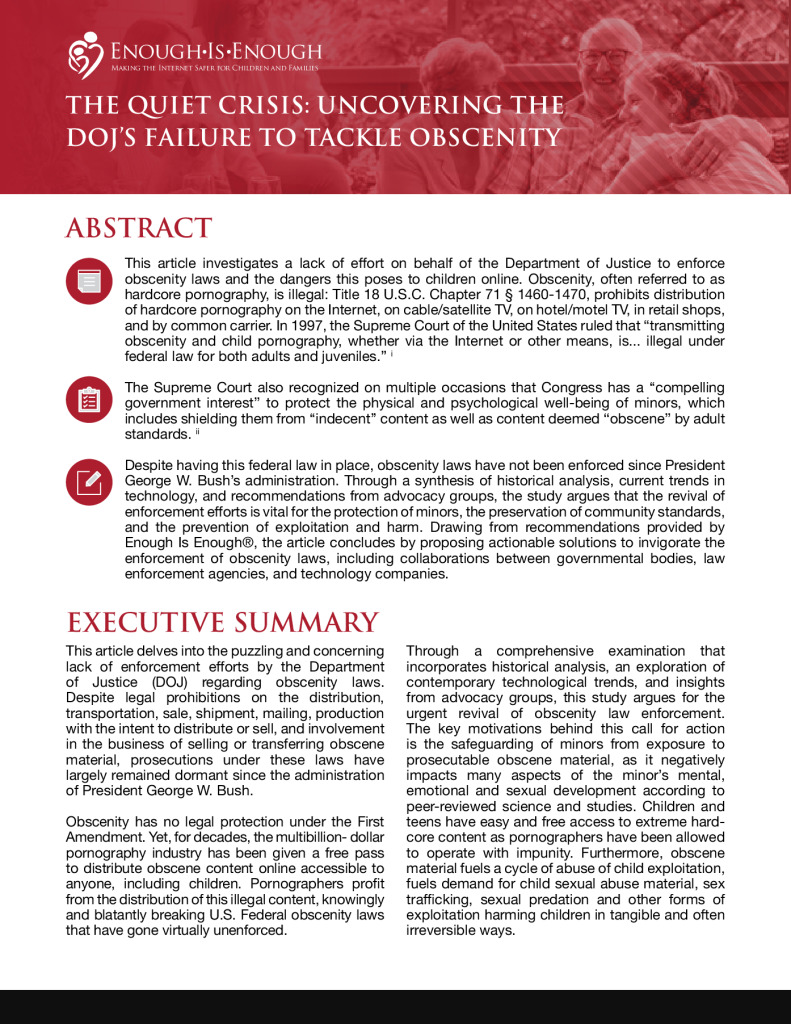
- Obscenity (“hard-core pornography”) is graphic material that focuses on sex and/or sexual violence. It includes close-ups of graphic sex acts, lewd exhibition of the genitals, and deviant activities such as group sex, bestiality, torture, incest, and excretory functions. There are federal obscenity laws that criminalize distribution of obscenity on the internet, but they have not been vigorously enforced.
- Child pornography (child sex abuse material) is material that visually depicts children under the age of 18 engaged in actual or simulated sexual activity, including lewd exhibition of the genitals.
Transmitting obscenity and child pornography, whether via the internet or other means, is already illegal under federal law for both adults and juveniles.
– Reno v. ACLU, 521 U.S. 844 (1998)
Kids have easy and anonymous access to all forms of the above-mentioned pornography through the internet.
The pornography industry often uses many different marketing tactics to attract viewers and lure kids, and their marketing models prioritize maximizing clicks, not ensuring that users are adults. In fact, most pornography sites do not request age verification of their visitors and even offer free samples of pornographic images. Some of the “responsible” pornography sites include an entry page that warns viewers to only enter if they are over 18, but in reality, anyone can gain access by simply clicking on a link that reads, for example, “I am 18 years or older.”

How do Pornographers Target Kids?
Free Teaser Images
Pictures and/or streaming videos posted on the home page of a pornographic site to entice users, including:
- Sexual activity of every form (i.e., sexual intercourse, masturbation, bisexual interactions, group sex, oral sex, fetishes)
- Cybersex and cyberchats with “live” feeds (i.e., user can view and/or interact in real time with porn star)
- Site “tours” (i.e., walks user through a virtual table of contents of pictures, videos, and pornographic experiences available)
Innocent Word Searches
Pornographic website operators use popular terms or innocent words that may have little or nothing to do with the content they display to increase traffic to pornographic sites.
Misspelled Words and Stealth Sites
Online pornographers often purchase “Stealth URLs.” These are sites with web addresses that are close in name to the “legitimate” site.
Cartoon Characters and Child Icons Pop-ups & Ad Banners
Many popular sites and social networking spaces have advertising/banner space for purchase. Pornographers often purchase this space hoping to draw young users to their sites.
Free Flash Games
A simple, interactive game, usually integrated into a website of similar games that can be played quickly, with little learning curve and no need to save the game’s progress. Popular genres include puzzle games, word games, card games, and uncomplicated animated games.
E-mail Spam (“junk e-mail”) Mousetrapping
This crafty tech-trick prevents user from escaping a pornographic site.
Looping
A seemingly never-ending stream of pornographic pop-ups to the computer screen. The only way to stop the pop-ups is to shut down the computer.
Porn-Napping
Pornographers purchase expired domain names so what was once a legitimate web address for a benign company or site now takes users to a pornographic site.
Attention-Grabbing Imagery
Predatory tactics often include using misleading titles or thumbnails on video, advertising on apps and websites popular with young people.

How Does Pornography Harm Kids?
- Has a negative impact on the emotional and mental health of children
- Fosters sexual “mis-education”
- Is a counterfeit for erotic love and intimacy
- Diminishes sexual satisfaction
- Teaches “Adult Entertainment” is normal and desirable
- Desensitizes the viewer and increases an appetite for more deviant, bizarre, or violent types of pornography
- Images viewed can never be erased
- Facilitates sexual aggression
- Can lead to objectification (obsessive fetishes over body parts and the rating of women by size and shape)
- Can lead to “acting out” sexually against other children based on what they have seen.
- Can lead to increased sexual callousness toward women
- Addiction to pornography can develop
- Can cause some to trivialize rape as a criminal offense
- Pornography consumption is associated with decreased brain volume in the right striatum, decreased left striatum activation, and lower functional connectivity to the prefrontal cortex.
Peer-reviewed research and medical science shows that internet pornography is a fueling factor in the sexual exploitation and abuse of children. Seventy- three percent of teens age 13 to 17 have watched pornography online. More than half (54%) reported first seeing pornography by the time they reached the age of 13 (Common Sense Media, “Teens and Pornography, 2023). Even more disturbing is the fact that 45% said porn gave them helpful information about sex; while 27% said porn showed an accurate representation of how people have sex.

The Drug of the new Millennium
Brain Imaging Studies
During certain critical periods of childhood, a child’s brain is being programmed for sexual orientation. Studies have shown that the prefrontal part of the brain that controls common sense, judgment, and emotion is not mature until approximately 21 years of age. Exposure to healthy sexual norms and attitudes during this critical period can result in the child developing a healthy sexual orientation. In contrast, if there is exposure to pornography during this period, thoughts of sexual deviance may become imprinted on the child’s “hard drive” and become a permanent part of his or her sexual orientation.
Dopamine, the brain’s primary reward neurotransmitter, is released whenever a person experiences pleasure. When there is a repetitive release of dopamine over time, the reward center of the brain becomes altered, leaving a person needing more stimulus to achieve the same result.

Compulsive Habituation
Studies show when a child or adolescent encounters Internet pornography, it can have lasting negative or even traumatic effects on the child’s sense of security and sexuality; that it promotes the belief that superior sexual satisfaction is attainable without having affection for one’s partner, thereby reinforcing the commoditization of sex and the objectification of humans; and that children who have been exposed have an increased risk for developing sexual compulsions and addictive behavior.
Exposure to Pornography May Incite Children to Act Out Sexually Against Other Children

Children often imitate what they’ve seen, read, or heard.. When kids watch sex, it’s no surprise they want to act out sexually. Some studies suggest that exposure to pornography can prompt kids to act out sexually against younger, smaller, and more vulnerable children.
Clinicians, psychologists, and law enforcement officials have noted an increase in the number of children seeking clinical help for issues relating to sexual exploitation; an increase in the number of children “acting out” sexually and a jump in the incidences of child-on-child sex attacks; and increased incidences of children creating self-generated sexual imagery.
2022 was the first year that ‘self-generated’ child sexual abuse reports of 7-10-year-olds were more prevalent than ‘not self-generated’ reports. In some cases, children are groomed, deceived or extorted into producing and sharing a sexual image or video of themselves by someone who is not physically present in the room with the child. Sometimes children are completely unaware they are being recorded and that there is then an image or video of them being shared by abusers.
Children aged 11-13 continue to appear most frequently in ‘self-generated’ imagery, as in previous years. We also continued to observe an increase in the proportion of this type of imagery including children aged 7-10 in 2023, up 65% from 2022 (104,282 in 2023 vs 63,057 in 2022).
– Internet Watch Foundation
Warning Signs That a Child May Be Viewing Pornography
Be alert. Be aware. It could happen in your own home, when you least expect it.
– Rene, Mother of an Internet pornography victim

Your child may be viewing pornography if you discover the following:
- An unusual curiosity about sexuality for his or her age
- Signs of premature sexual activity
- Unusual or unexplained credit card charges
- Increased pop-ups or inappropriate e-mails on your computer
- Computer screen changes quickly when you walk into a room
- Noticeable changes in behavior, including increased secretiveness or defensiveness, or possibly acting out on others, including other children.
Image-based Sexual Abuse (IBSA): Image Based Sexual Abuse (IBSA) encompasses a range of harmful activities that weaponize sexually explicit or sexualized materials against the persons they depict. IBSA includes the creation, theft, extortion, threatened or actual distribution, or any use of sexually explicit or sexualized materials without the meaningful consent of the person or persons depicted and/or for purposes of sexual exploitation. It also includes sexual violence or harassment committed towards a person’s representation (e.g., a person’s avatar) in virtual reality or online gaming. If the victim is age 18 and above, it is not considered a form of CSAM or OSEAC.
Plan:

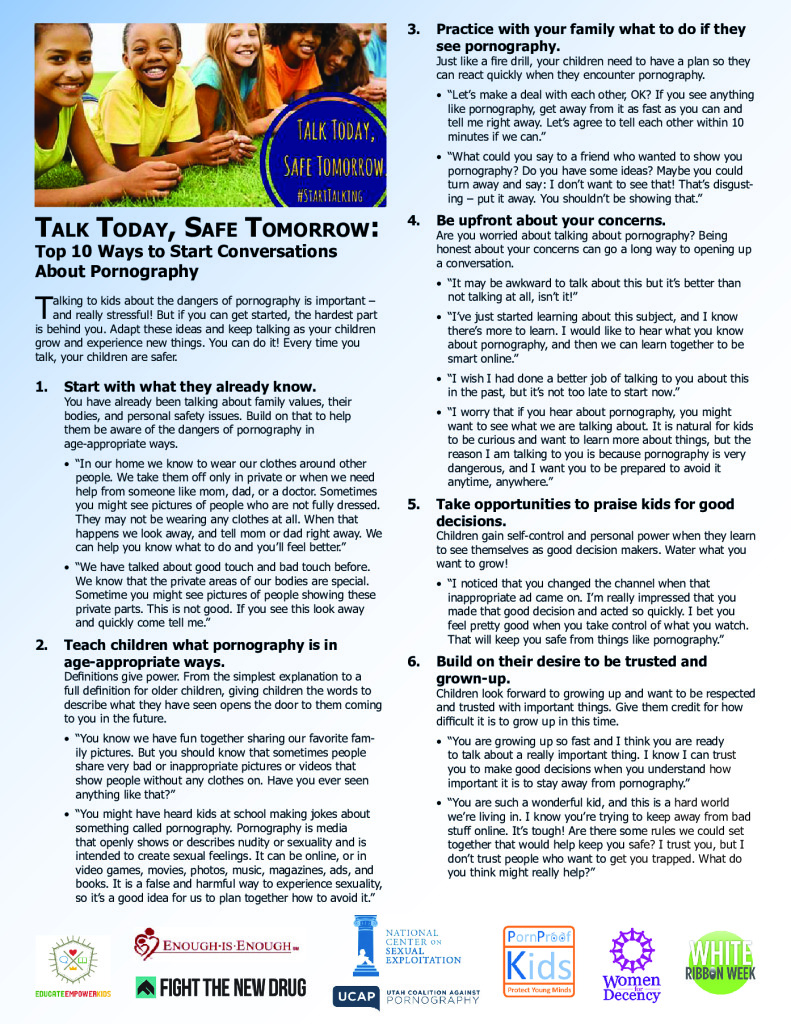
Most of us find it difficult to talk to our children about sex in general, let alone, the harmful effects of pornography. Yet, it’s important to remember that even if your children are not looking for internet pornography, chances are, they have come across harmful sexual content at some point–or they will in the future– and it is your job to protect and guide them about their natural questions about sex.
If I was a parent, I’d want to establish that relationship with my kid and to actually be honest with them and talk to them, and say, ‘I went through this, and even seeing pornography once can just hurt you so much. Seeing little pictures can put all these things in your mind.’ It’s just horrible.— Aaron, Age 19
Children and adolescents need accurate, age-appropriate information about sexuality from their family as the primary source of sexual education, who can provide information aligned with family values and their child’s emotional readiness. Those who don’t feel comfortable having open and honest conversations about healthy sexuality often turn to internet pornography which often depicts unrealistic or harmful scenarios that can distort understanding of healthy sexual relationships.
By having a plan, which includes ongoing conversations to discuss potentially difficult topics, parents can create a safe space for questions, clarification, and discussion of important topics like emotions, relationships, consent, and safety. When parents establish early, open dialogue, children feel more comfortable asking questions rather than seeking potentially harmful or inaccurate information from unreliable sources.
Parents are uniquely positioned to address crucial aspects of sexuality that pornography typically ignores or misrepresents, such as body image, healthy relationships, and consent. This guidance helps young people develop critical thinking skills about media messages regarding sex and relationships. These conversations also build trust and keep communication channels open for other sensitive topics that may arise throughout adolescence.
Prevent:
THE TEN "Rules ‘N Tools®" FOR CHILD ONLINE SAFETY
Offensive and defensive strategies designed to protect the innocence and safety of children in the digital world.
Implementing both Safety "Rules" and Software "Tools" on all digital devices, online platforms and services used by your child will help to ensure a safer online experience for them, and peace of mind for you. One without the other is ineffective.
"Rules" A Parent’s Offensive Strategy (Non-technical measures)
- Communicate often about online privacy and safety with your child:
- Talk regularly about online activities and stay engaged and involved; build an atmosphere of trust early on.
- Encourage them to think before they post and avoid sharing personally identifiable information (PII) including date of birth, address, full name, school, or other information that can be used to identify and track down a child.
- Instruct them to never send or share explicit images or messages.
- Teach them to avoid meeting in person with someone they only met online because they cannot recognize a disguised predator.
- Direct them to use safe search engines and cybersecurity protections.
- Require parental permission before using third-party apps as many access private information and profiles.
- Warn then about the very real dangers about online predators, traffickers and grooming tactics. Recognize red flags and avoid anyone who attempts to move conversations to unmonitored platforms, private spaces, text and email.
- Use privacy settings on all social media and gaming platforms and block strangers.
- Instruct them to report any inappropriate or threatening messages or requests to social media or gaming platforms, or to authorities if necessary. Tell a parent immediately.
- Supervise your child’s online activities:
- Ensure your child feels safe discussing anything they encounter without fear of parent overreaction. Be a trusted adult. Remind them that no conversation is off limits.
- Consider delaying access to internet-enabled devices until you are certain your child can demonstrate responsible digital habits and the maturity to use and manage technology appropriately.
- Approve all apps, games and platforms your child uses.
- Friend/follow your child’s accounts and know their usernames, passwords and login details on all devices.
- Monitor posts, photos/videos, browser history, messaging and location sharing settings.
- Teach your child digital etiquette:
- Practice the Golden Rule: “Do unto others as you would have them do unto you.”
- Avoid harmful bullying, gossip or hurtful posts; there are no “take backs”.
- Respect others’ privacy and avoid sharing embarrassing content.
- If you see something, say something. If you believe someone you know is in harm's way, tell a trusted adult.
- Teach your child responsible device and technology use:
- Follow family technology rules at home and away. Maintain full transparency about texts, messages and apps, avoid “hiding” online activities.
- Create online accounts and adjust privacy settings/parental controls only with parent/guardian permission.
- Share physical location with parent/guardian permission, and keep location services active only for direct family.
- Care for and maintain phones and devices, keeping them charged.
- School, homework, extracurricular activities and family relationships come before device use.
- Implement family agreements:
- Review our “Family Contract for Smartphones & Digital Devices” and share it with your child’s grandparents and relatives.
- Teach your child from an early age that technology is a tool, not a toy, and is a privilege, not a right.
- Demonstrate responsible technology use through a collaborative effort - both the child and the parent must demonstrate self-discipline and lead by example.
- Establish the consequences in advance for failure to abide by the family agreement.
"Tools" A Parent’s Defensive Strategy ("Technical Measures")
Parental controls should be utilized on all internet-enabled devices and platforms including desktops, laptops, gaming consoles, mobile phones, music devices and related apps. Most operating systems - such as Windows (Microsoft accounts), macOS (Apple ID), Chrome OS (Chromebook accounts), and Android (Google accounts) - offer built-in parental controls, as do app stores and some routers.
Remember, technology tools are not a substitute for parental supervision as determined kids can usually find a work-around.
- Set age-appropriate filters, time limits and utilize monitoring software by using a password only known by the parent.
- Ensure privacy settings are enabled on social media, gaming, and mobile devices. Limit online communications to parent-approved friends and platforms, especially for kids K-8.
- Regularly check browser history.
- Restrict chat room access; limit live audio and video chat for younger children. Only allow live audio chat features with extreme caution and only with approved contacts
- Keep cybersecurity software up to date on all devices.
Respond: Seeking Help
My child has stumbled upon online pornography—now what?
Don’t overreact or shame your child; rather, engage them in a conversion so they will come to you again when it happens in the future.
First, try to:
- Understand that children are naturally curious about sex
- Realize that kids need and want adult guidance
- Educate your child about healthy sexuality, respect for themselves and the opposite sex
- Help your child to replace counterfeit messages with messages of wholesome sexual values
Professional help may be required if your child is traumatized by imagery or you sense an addiction to pornography has developed.
Should I Seek Help for My Child?
If you should find that your child has been exposed to online pornography, it would be natural for you as a parent to wonder if you need to seek professional help for your child. Initially, it will be important to ascertain the severity of the pornographic content your child viewed. Were the images seen limited to images of body parts? Did they include graphic sexual acts, violence, or bestiality? Did the child later imitate aspects of what he or she saw on another sibling or child?

Oftentimes, the decision to seek outside professional help is made on a case-by-case basis and depends on the child’s age. For example, if your teenage child accidentally stumbled upon pornographic images and had an open discussion about what was seen with you, then chances are you may determine that you do not necessarily need to seek help for your child. However, if a child is clearly traumatized by the images viewed online, regularly views pornography, or later “acts out” against another child, you will want to consider seeking the help of a trained therapist.
The key is not to overreact or shame your child; rather, create an open and loving environment where you and your child can openly discuss what has been seen. Then, you will be able to better determine the appropriate course of action.
Regardless of what was viewed, the goal is to help heal your child and relieve any suffering he or she may be experiencing—not to punish your child.
Keep the lines of communication open by listening to what your kids say and what they don’t say.
Ask your children:
- Have you ever seen something online that made you uncomfortable or curious?
- Have you accidentally seen sexual pictures online?
- How did that happen? What did you do? How did it make you feel?
- Have any of your friends ever accessed pornography? Accidentally or intentionally?
Report
TO REPORT CHILD PORNOGRAPHY, OBSCENITY, OR TO REPORT A CYBERCRIME: www.cybertipline.com
Or call: 1-800-THE-LOST (provided by the National Center for Missing and Exploited Children). The congressionally mandated CyberTipline is a reporting mechanism for cases of child sexual exploitation including child pornography, online enticement of children for sex acts, molestation of children outside the family, sex tourism of children, child victims of prostitution, and unsolicited obscene material sent to a child. Reports may be made 24 hours per day, 7 days per week.