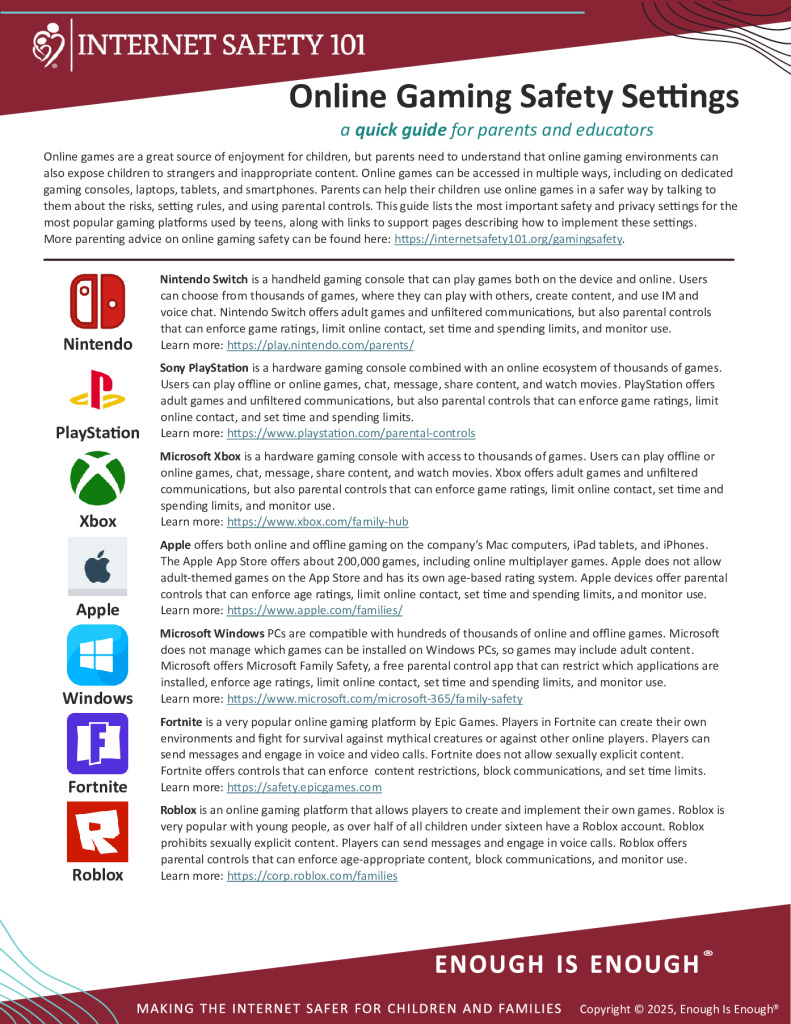
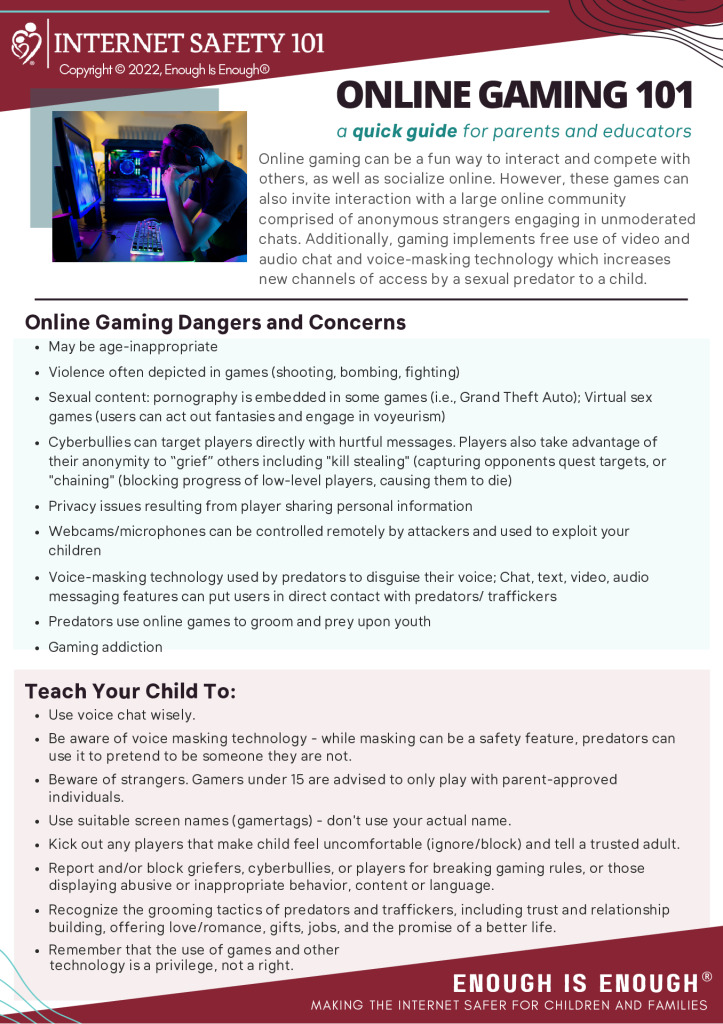
Children see the online gaming world as a virtual playground. Gaming consoles operate much in the same way as a computer—children can log online, put on a headset, turn on a webcam, and talk to and play with any of the millions of gamers around the world. Many online games have associated online communities, making online games a form of social activity beyond single-player games.
Gaming is popular among teens – especially teenage boys. More than 8 in 10 teens say they have a game console at home or have access to one, and 90% say they play video games on a computer, game console or cellphone, according to the Pew Research Center.
Digital games are an integral part of children’s lives, as 8- to 18-year-olds spend approximately 1.5 hours per day playing them (Rideout & Robb, 2019), and 76% of US children under the age of 18 play digital games (Entertainment Software Association, 2023)
Online gaming can be a fun way to interact and compete with others, as well as socialize online. However, several concerns have emerged of which parents should be aware of as games become more realistic and playing partners can include anonymous strangers engaging in unmoderated chats. Further, online gaming incorporates the free use of video and audio chat, as well as voice-masking technology which increases new channels of access by a sexual predator to a child.
Online gaming devices are just like a computer and a lot of parents don’t realize that. There are messaging, chat and IM features. Using an Xbox, you can receive messages from any of the major platforms. Even if you’re in the game, somebody who has your game ID or screen name can send a text message to you and it will pop up on the screen and you can chat just like you do on a computer.
— Chad Gallagher, Child Exploitation Squad, FBI
Online Gaming Risks
DID YOU KNOW…
Many popular games allow users to disguise their voices. As entertaining as interactive gaming can be, parents should be aware that their children can speak using their own voice with strangers online. Police say predators use this feature to make themselves sound younger. More sophisticated voice changers can make an older man sound like a young boy.
Online Gaming risks and concerns include the following:
- May be age-inappropriate
- Violence often depicted in games (shooting, bombing, fighting)
- Sexual content: pornography and other sexual content is embedded in some games (i.e., Grand Theft Auto)
- Virtual sex games (users can act out fantasies and engage in voyeurism)
- Cyberbullies can target players directly with hurtful messages. Players also take advantage of their anonymity to “grief” others including “kill stealing” (capturing opponents quest targets, or “chaining” (blocking progress of low-level players, causing them to die)
- Privacy issues resulting from player sharing personal information
- Webcams/microphones can be controlled remotely by attackers and used to exploit your children
- Voice-masking technology can be misused by predators and other dangerous people to disguise their voice; Chat, text, video, audio messaging features can put users in direct contact with predators/ traffickers
- Predators use online games to groom and prey upon youth
- Gaming addiction is a growing problem among today’s youth
Predators & Gaming
Visually stunning graphics, intense action sequences, and fast-paced gameplay provide a high level of sensory stimulation that captivates children and teens. Online games allow for a high degree of interactivity, where players can directly impact the game world and outcomes through their actions. This sense of control and immersion can be highly engaging, as well as the ability to interact, collaborate, and compete – each of which fosters a sense of community.
However, the anonymity afforded to offenders and the insufficient oversight of young users in many online games create a perfect storm, transforming these virtual environments into breeding grounds for predators seeking to exploit vulnerable children – often without the victims even realizing they are being targeted.
I was experiencing a lot of turmoil as a fifth, sixth grader, transitioning into middle school …I found a lot of solace in online gaming… I finally met a friend, his name was Adam, I was 12 years old. We played games like anybody else did. He was 19 years old at the time… he started sending me pornographic content. He would send me stuff from the internet… I would wake up in the morning and play games and go to school and come home and play games and watch porn. And like, that was my life.
— Harrison Haynes, Digital Intentionalism Advocate, Survivor Consultant

There are several key risks that children can face from online predators while playing online games:
- Grooming: Predators may try to befriend and build trust with children through the online game, with the goal of eventually exploiting or sexually abusing them.
- Solicitation of explicit content: Predators may try to convince children to send them nude photos, videos, or engage in sexual activities online.
- Luring offline: Predators may try to get children to meet them in person, with the intent of abducting or sexually assaulting them.
- Financial exploitation: Predators may try to manipulate children into sharing financial information or making in-game purchases that benefit the predator.
- Cyberbullying and harassment: Predators may use the online game platform to harass, threaten, or bully children.
The anonymity and lack of supervision in many online games makes them prime hunting grounds for predators looking to target vulnerable children. It’s critical that parents closely monitor their children’s online activities, set strict rules, and educate them on online safety to help mitigate these risks. Installing parental control software, limiting game time, and having open conversations about online dangers are all important steps.
Sexualized Content & Gaming
There is growing concern about the presence of sex and hypersexualized content in online games played by children. Many of these games, while seemingly age-appropriate on the surface, contain avatars, dialogue, or user-generated content that promote unrealistic and often adult-themed depictions of sexuality. This exposure can have harmful effects on children’s mental and emotional development, influencing their understanding of body image, relationships, and consent at a stage when they are still forming their identities.
Additionally, online multiplayer games often lack sufficient moderation, allowing inappropriate language, behaviors, and even predatory interactions to occur. The lack of strict age verification and effective parental controls can make it difficult to shield young players from these influences, raising serious concerns about their safety and well-being in digital environments.
Parents need to understand how intricately linked the gaming industry and pornography industry are. More and more games have pornography embedded in them. If kids play online, that is a pornographer’s heyday for marketing, grooming and hooking young consumers.
— Jill Manning, Ph.D. Marriage and Family Therapist
Gaming Addiction
Gaming Addiction
Gaming addiction and gaming disorder are terms that are often used interchangeably, but they have distinct meanings, especially in clinical contexts. Gaming addiction is an informal term used to describe excessive or compulsive gaming behavior that interferes with daily life. It is commonly used in everyday language, particularly by concerned parents, educators, or the media, and does not have a standardized definition or recognized medical criteria.
Excessive gaming can have a detrimental impact on mental health, triggering a host of debilitating conditions. These include ADHD, depression, anxiety, mood disorders, and even autistic-like symptoms known as “virtual autism”. The immersive and often highly rewarding nature of video games can also lead to full-blown addiction, where the virtual world takes precedence over real-life responsibilities and relationships.
This digital dependency bears striking similarities to substance abuse, providing both temporary relief and the risk of dangerous dependence. Furthermore, it can result in severe sleep deprivation and heighten aggressive tendencies.
If they are sleep deprived, then that’s when you know there could be a potential problem. When you ask [a child] to cut back, for example, they may get really agitated. That could be a sign of an addictive problem that needs to be addressed. Or they’re acting guilty when they’re playing, like they’re sneaking off or they’re lying about their playing….So every day, every morning, if that’s all they’re talking about, and that’s what is the number one thing on their mind, that could be a problem. That leads to mood problems, for example, like ADHD problems, emotional problems, depression, anxiety, and cutting behaviors.
– Andrew P. Doan, M.P.H., M.D., Ph.D.
Gaming and Screentime Addiction Expert
Gaming Disorder
“Gaming disorder” is defined in the 11th Revision of the International Classification of Diseases (ICD-11) as a pattern of gaming behavior (“digital-gaming” or “video-gaming”) characterized by impaired control over gaming, increasing priority given to gaming over other activities to the extent that gaming takes precedence over other interests and daily activities, and continuation or escalation of gaming despite the occurrence of negative consequences.
For a gaming disorder to be diagnosed, the behavior pattern must be of sufficient severity to result in significant impairment in personal, family, social, educational, occupational or other important areas of functioning and would normally have been evident for at least 12 months.” – The World Health Organization
Preventing Online Gaming Addiction
Preventing online gaming addiction in children starts with creating a healthy balance in their daily lives. Parents should encourage routines that include schoolwork, physical activity, family time, and offline hobbies, ensuring that gaming is just one of many activities. Setting clear, consistent time limits is important, and using tools like timers or parental control apps can help manage screen time without constant conflict.
It’s also helpful to guide children toward games that have natural stopping points and avoid those designed to be endlessly engaging or addictive. Teaching children to be self-aware of how gaming affects their mood and behavior can encourage healthier habits, and parents should model balanced tech use themselves to reinforce the importance of moderation.
If Online Gaming Disorder Has Developed
If a child has already developed signs of this disorder, it’s crucial for parents to respond with empathy rather than anger. Starting a calm, supportive conversation can open the door to understanding the underlying reasons for excessive gaming. Boundaries may need to be re-established, but it’s often more effective to gradually reduce gaming time and replace it with other engaging, real-world activities. Involving the child in the process of setting new routines can give them a sense of control and responsibility.
Parents should also watch for emotional or behavioral changes, as gaming addiction can sometimes be linked to anxiety, depression, or social withdrawal. If these signs are present or if the situation becomes unmanageable, seeking help from a counselor, therapist, or pediatrician is a constructive step. Ultimately, the focus should be on fostering open communication, strengthening real-world connections, and supporting the child in building a healthier relationship with technology.
If online gaming disorder is suspected, seek the support of a licensed mental health practitioner with experience in treating this disorder.
If they have a problem, consider a digital detox where you literally take everything away for a month and let their brain reset. After the brain resets, then you may want to reintroduce the more appropriate screen time….And if that doesn’t work, then you may have to go longer in detox because you may have a child with a really bad addiction and you may need a mental health provider now to help you intervene.
– Andrew P. Doan, M.P.H., M.D., Ph.D.
Gaming and Screentime Addiction Expert

Artificial Intelligence and Gaming
Artificial intelligence (AI) can pose several risks to children who engage in online gaming. AI-powered algorithms are often used in games to enhance user engagement, which can lead to addictive behaviors, especially in children whose self-regulation skills are still developing. Additionally, AI-driven chatbots or in-game characters may interact with players in ways that blur the lines between real and artificial relationships, potentially exposing children to inappropriate content or manipulation.
AI-driven recommendation systems (like in chat or game suggestions) can inadvertently expose children to inappropriate content or conversations that are not age-appropriate. It can also be used to create chatbots or fake profiles that mimic real people. These could be used by predators to befriend children and gain their trust.
There is also the risk of AI being used to collect and analyze children’s personal data without proper consent, raising concerns about privacy and data security. AI can be exploited by malicious users to create realistic deepfakes or fake profiles that deceive and potentially groom vulnerable players. These risks highlight the need for stronger safety regulations and parental oversight in AI-powered gaming environments to protect young users.
With the advent of Artificial Intelligence, I can now simply machine learn someone’s profile and groom children at mass.
— Testimony of CEO John Pizzuro, Raven, Feb. 19, 2024 (U.S. Senate)
Virtual Reality
Virtual Reality (VR) introduces unique risks to children who engage in online gaming. While VR offers an immersive and engaging experience, it can also be overwhelming for young minds.
Prolonged use of VR can lead to issues like eye strain, headaches, and motion sickness due to the sensory overload and intense interaction. Furthermore, VR can blur the line between the virtual and real world, making it harder for children to distinguish what is real, which can lead to confusion, distress, or inappropriate behavior. The immersive nature of VR also heightens concerns about exposure to violent, sexual, or disturbing content, as it can feel more personal and immediate than traditional gaming. Additionally, VR can create social risks, as children may interact with strangers in online multiplayer environments, which can expose them to cyberbullying, inappropriate language, or even predatory behavior.
Lastly, VR gaming typically involves physical movement, which, while beneficial for exercise, can increase the risk of injury if children aren’t properly monitored or if the play area isn’t safe. To mitigate these risks, parents should set clear usage boundaries, monitor content carefully, and ensure that their child takes regular breaks to avoid physical and psychological strain.
Plan:
Parents and caregivers need to be proactive and informed before allowing children and youth to take part in online gaming.
- Educate yourself about the games your child plays—check ratings, read reviews, and explore the type of content in each game. Play the game yourself so you understand your child’s gaming experience.
- Set clear boundaries around screen time, types of games allowed, and online interactions.
- Talk with your child early about online safety and safe gaming practices, including the importance of not sharing personal information and what kinds of behavior are inappropriate.
- Create a family plan that includes where, when, and how games can be played (e.g., in common areas, not during meals or before bed, not during the school day).
- Know the platform controls and settings—each console or device has different parental control features. Learn how to use them.
Prevent: Rules ‘N Tools:
Whether your child is gaming at home or elsewhere, it’s important to talk with them about the risks of online gaming and encourage smart, age-appropriate choices. Be open to listening if they seem upset about something that happened while playing, and guide them to use good judgment when choosing games. You can help make their gaming experience safe, friendly, and even educational by learning about the gaming community, checking game ratings, and using built-in privacy and safety tools available in most games.
- Teach online gaming safety: Kids should avoid sharing personal info, use appropriate gamertags, and only play with trusted, parent-approved players.
- Voice chat awareness: Discuss the risks of voice masking, exposure to profanity, and the option to disable chat or use avatars, especially for younger gamers.
- Cyberbullying & predators: Encourage kids to block/report suspicious or abusive players and talk to a trusted adult if they feel unsafe.
- Play and review games: Play alongside your child and check game ratings (e.g., ESRB) to ensure age-appropriateness.
- Limit access to risky features: For children under 16, disable or monitor webcam use, web browsing, and voice masking; be aware of guides teaching kids to bypass controls.
- Discuss gaming-related purchases: Have your child check with you before attempting to enter any credit card information. Consider setting controls to require your parent PIN on purchases and to restrict access to games, including free games in the online store via your PIN.
- Monitor well-being: Watch for signs of gaming addiction, isolation, aggression, or depression; seek help if serious behavior changes occur.
- Promote balance: Encourage offline activities, outdoor play, and social interaction to support healthy habits.
THE TEN "Rules ‘N Tools®" FOR CHILD ONLINE SAFETY
Offensive and defensive strategies designed to protect the innocence and safety of children in the digital world.
Implementing both Safety "Rules" and Software "Tools" on all digital devices, online platforms and services used by your child will help to ensure a safer online experience for them, and peace of mind for you. One without the other is ineffective.
"Rules" A Parent’s Offensive Strategy (Non-technical measures)
- Communicate often about online privacy and safety with your child:
- Talk regularly about online activities and stay engaged and involved; build an atmosphere of trust early on.
- Encourage them to think before they post and avoid sharing personally identifiable information (PII) including date of birth, address, full name, school, or other information that can be used to identify and track down a child.
- Instruct them to never send or share explicit images or messages.
- Teach them to avoid meeting in person with someone they only met online because they cannot recognize a disguised predator.
- Direct them to use safe search engines and cybersecurity protections.
- Require parental permission before using third-party apps as many access private information and profiles.
- Warn then about the very real dangers about online predators, traffickers and grooming tactics. Recognize red flags and avoid anyone who attempts to move conversations to unmonitored platforms, private spaces, text and email.
- Use privacy settings on all social media and gaming platforms and block strangers.
- Instruct them to report any inappropriate or threatening messages or requests to social media or gaming platforms, or to authorities if necessary. Tell a parent immediately.
- Supervise your child’s online activities:
- Ensure your child feels safe discussing anything they encounter without fear of parent overreaction. Be a trusted adult. Remind them that no conversation is off limits.
- Consider delaying access to internet-enabled devices until you are certain your child can demonstrate responsible digital habits and the maturity to use and manage technology appropriately.
- Approve all apps, games and platforms your child uses.
- Friend/follow your child’s accounts and know their usernames, passwords and login details on all devices.
- Monitor posts, photos/videos, browser history, messaging and location sharing settings.
- Teach your child digital etiquette:
- Practice the Golden Rule: “Do unto others as you would have them do unto you.”
- Avoid harmful bullying, gossip or hurtful posts; there are no “take backs”.
- Respect others’ privacy and avoid sharing embarrassing content.
- If you see something, say something. If you believe someone you know is in harm's way, tell a trusted adult.
- Teach your child responsible device and technology use:
- Follow family technology rules at home and away. Maintain full transparency about texts, messages and apps, avoid “hiding” online activities.
- Create online accounts and adjust privacy settings/parental controls only with parent/guardian permission.
- Share physical location with parent/guardian permission, and keep location services active only for direct family.
- Care for and maintain phones and devices, keeping them charged.
- School, homework, extracurricular activities and family relationships come before device use.
- Implement family agreements:
- Review our “Family Contract for Smartphones & Digital Devices” and share it with your child’s grandparents and relatives.
- Teach your child from an early age that technology is a tool, not a toy, and is a privilege, not a right.
- Demonstrate responsible technology use through a collaborative effort - both the child and the parent must demonstrate self-discipline and lead by example.
- Establish the consequences in advance for failure to abide by the family agreement.
"Tools" A Parent’s Defensive Strategy ("Technical Measures")
Parental controls should be utilized on all internet-enabled devices and platforms including desktops, laptops, gaming consoles, mobile phones, music devices and related apps. Most operating systems - such as Windows (Microsoft accounts), macOS (Apple ID), Chrome OS (Chromebook accounts), and Android (Google accounts) - offer built-in parental controls, as do app stores and some routers.
Remember, technology tools are not a substitute for parental supervision as determined kids can usually find a work-around.
- Set age-appropriate filters, time limits and utilize monitoring software by using a password only known by the parent.
- Ensure privacy settings are enabled on social media, gaming, and mobile devices. Limit online communications to parent-approved friends and platforms, especially for kids K-8.
- Regularly check browser history.
- Restrict chat room access; limit live audio and video chat for younger children. Only allow live audio chat features with extreme caution and only with approved contacts
- Keep cybersecurity software up to date on all devices.
Respond:
If issues arise:
- Stay calm and listen if your child reports or displays signs of distress, inappropriate interactions, or behavior changes related to gaming.
- Document and report any inappropriate, abusive or predatory behavior to game moderators or platform provider. Look for a “Report Abuse” or similar option as many games have built-in reporting features, often accessed through the game’s user interface or a user’s profile page. Report to authorities if necessary. For child exploitation: If you believe the content involves child sexual abuse or exploitation, you can report it to the National Center for Missing & Exploited Children’s CyberTipline.
- Block and remove problematic games or users from your child’s access.
- Reassess boundaries and talk through what happened with your child so they understand and learn from the experience.
- Seek support from school counselors, online safety organizations, or parenting resources if you’re unsure how to proceed.
- Seek Professional support and treatment if you suspect your child has developed internet gaming disorder from someone experienced in this field.