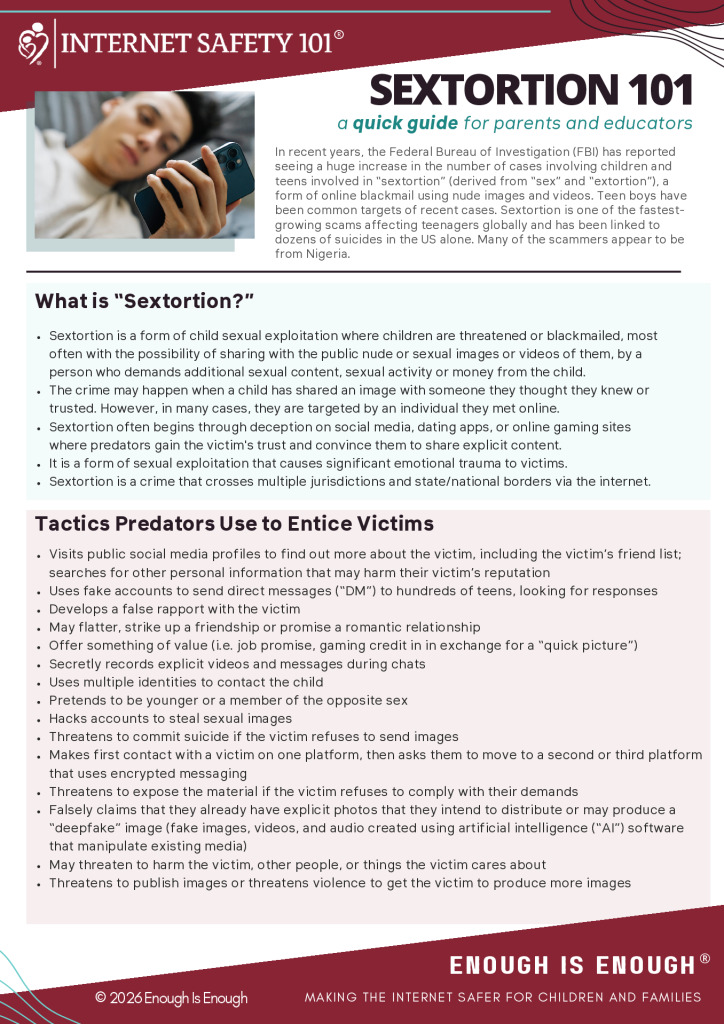
Online sexual exploitation and abuse of children (OSEAC) refers to any situation where a child is manipulated, coerced, or forced into sexual activities over the internet. It includes a wide range of harmful behaviors, such as:
These forms of exploitation can happen on social media, messaging apps, gaming platforms, and other online spaces. It is a serious crime with severe emotional, psychological, and legal consequences. Artificial intelligence (AI) plays a role in both enabling and combating online sexual exploitation and abuse (OSEAC) of children.
Note: The term “Image Based Sexual Abuse” encompasses a range of harmful activities that weaponize sexually explicit or sexualized materials against the persons they depict. IBSA includes the creation, theft, extortion, threatened or actual distribution, or any use of sexually explicit or sexualized materials without the meaningful consent of the person or persons depicted and/or for purposes of sexual exploitation.
As it relates to those 18 and above, it not be included as a form of CSAM or OSEAC.
How Artificial Intelligence Enables OSEAC
Deepfake and AI-Generated CSAM – AI can be used to create fake child sexual abuse material (CSAM) by altering real images or generating entirely new ones, making it harder to detect and prosecute offenders.
While AI can be misused by predators, it is also a powerful tool in the fight against online child exploitation, helping to identify and stop abuse more efficiently than manual methods alone.
In 2023, the National Center for Missing and Exploited Children’s Cybertipline received 36.2 million reports of suspected child sexual exploitation online. Those reports contained more than 105 million images, videos and other files. There was also an explosion in reports of online enticement, an increase of more than 300% between 2021 – 2023. The majority of reports received were related to the circulation of child sexual abuse material (CSAM), but other trends indicated by the data were the continued rise in reports of financial sextortion and the use of generative AI in child sexual exploitation.
What does an online predator “look like”?
The online predator:
- Blends into society
- Is typically clean cut and outwardly law abiding
- Uses position in society to throw off suspicion
- Can rise to be a pillar of society while actively pursuing children
- Often engages in activities involving children
- Appears trusting to both parents and child
- Can literally be anyone- coming from any profession, background or socio-economic status
What Fuels Online Predators?
- Easy and anonymous access to children
- Hides behind anonymity of the internet
- Risky online behaviors by minors (ex. sharing explicit photos or content)
- Aware of difficulty of law enforcement to keep up with volume of online sexual exploitation
- Easy access to child sexual abuse material (CSAM)

How Do Predators and Traffickers Groom and Entice Kids and Youth?
Online predators can easily access unsuspecting children through direct messaging, chat rooms, email, instant messaging, and social networking sites, simplifying their efforts to groom victims. Additionally, when children discuss personal or sexual matters with online acquaintances or strangers, they increase their risk of online grooming, which can occur over both short and extended periods.
- Targeting and Building Trust
- Predators look for vulnerable children on social media, gaming platforms, and chat apps.
- They pretend to be friendly, understanding, and interested in the child’s life, discussing popular music artists, sports or other activities or hobbies – drilling down on information the child may have previously shared online.
- They may pose as someone of a similar age/lie about their age
- Gaining Emotional Dependence
- Predators may affirm feelings and choices of the child; offer compliments, attention, and emotional support, making the child feel special.
- They may flatter and compliment the child excessively, send gifts and invest time, money and energy
- They may exploit loneliness, natural sexual curiosities about the child,
- May form an online relationship that becomes romantic, manipulative, or controlling and upon which the child becomes dependent, or exploit family conflicts and insecurities to pose as a “trusted friend.”
- They encourage secrecy, saying things like, “This is just between us.”
- May drive a wedge between the child and his or her parents and friends
- Introducing Sexual Content
- The predator slowly desensitizes the child by discussing relationships, sex, send inappropriate images or expose them to pornography.
- They may ask the child for personal photos, saying it’s “normal” or a way to show affection.
- Some use flattery, dares, or challenges to push boundaries.
- Exploitation and Control
- The predator pressures the child into sharing explicit images or engaging in sexual acts via video.
- They may use threats using the child sexual abuse material featuring their victims to blackmail them into silence (e.g., “If you don’t send more, I’ll share what you already sent”).
- In some cases, they manipulate the child into meeting in person.
- May threaten a family member, pet or friend or loved one whether or not they are being sex trafficked
“Group Grooming” and Exploitation
Sexual predators also use“group grooming” tactics to target and groom children for sexual exploitation, working together to target children as potential victims and expose children to explicit content and assess their openness to sexual exploitation.
In some instances, groups of online predators use each other to condone and normalize the exchange of sexually explicit materials within the group. Children who join games, chats, or online groups are unaware that they are engaging with adult online predators, and instead believe they are meeting with a group of their peers.

Child sexual abuse material (previously known as “child pornography”) is material that visually depicts children under the age of 18 engaged in actual or simulated sexual activity, including lewd exhibition of the genitals. A child cannot legally give consent to these acts, and yet these prosecutable crimes are just a click or a swipe away from viewing—whether intentionally or accidentally.
How Does Viewing CSAM Harm Individuals, Especially Children?
- Children whose sexual exploitation/abuse is depicted are forced to suffer a lifetime of re-victimization and trauma each time the image of their sexual abuse is viewed.
- Lasting psychological damage to the child may result, including disruptions in sexual development, self-image and difficulty developing trusting future trusting relationships.
- Sexual abuse of children is illegal, as are images depicting their abuse.
It is ALWAYS illegal to produce, distribute or possess child sex abuse material in the United States!
Report CSAM to www.cybertipline.com or call 1-800-THE-LOST.
The Role of “Sexting” and “Revenge Porn
- CSAM can be used by pedophiles as tools of sextortion, revenge porn and other forms of sexual exploitation and shaming.
- “Sexting,” or sending explicit or nude pictures or videos to others via cell phones, computers, social media or any digital device, may be a crime under both federal and state laws if the person depicted in the images is under the age of 18 years old.
- “Revenge porn” (also known as nonconsensual pornography) is the act of sharing or posting nude, partially nude, or sexually explicit
- Images of someone online without consent and is against both civil and criminal law.
- Child pornography charges can be brought under both state and federal child pornography laws whenever a person sends or receives an explicit image of a person under 18.
Conversation Starters:
Ask your child:
- What kind of information do you consider safe or unsafe to share online?
- Would it be easy for someone to track you down?
- Have you ever said/posted anything online you wish you could take back?
- Has anyone ever hurt your feelings with something they posted about you online?
- Have you been contacted online by a stranger? If so, what did you do/say?
- Has anyone ever asked you to send (or sent you) pictures or videos that made you feel uncomfortable?
- Do you know what the word ‘consent’ means?
- If someone said that you had to send them a picture or video “or else,” what do you think you should do?

Child Sexual Abuse Material generated through Artificial Intelligence (AI CSAM) is a growing area of concern.
While technology like Artificial Intelligence (AI) can be used for good, the potential misuse of AI to exploit children, particularly through the generation of child sexual abuse material (CSAM), is of great concern:
AI-Powered Grooming Bots: Some offenders use AI chatbots to engage with children, making initial contact and building trust before human predators take over.
Anonymity and Automation: AI can help offenders stay anonymous, evade detection, and even automate the spread of harmful content across platforms.
Deepfake images: AI can generate highly realistic “deepfake” images by:
- Studying real photographs of abused children to create new images showing those children in sexual positions.
- Overlaying faces of non victimized children onto bodies of abused children in existing abuse images.
- Combining data from photographs of both abused and non-abused children to create new, realistic sexualized images of children who don’t actually exist but may resemble real children.
Manipulation and Coercion: AI tools can mimic voices, alter images, or create realistic fake scenarios to deceive children into engaging in sexual activities online.
Location tracking: AI tools can scan and track images of children across the internet, potentially allowing malicious actors to approximate or even anticipate a child’s location. This poses a significant physical safety risk.
Voice mimicking: AI can study short voice recordings, such as those from voicemail or social media posts, and create convincing imitations of a person’s voice. The letter mentions that this technology has already been used by scammers to fake kidnappings, which could cause severe emotional distress to families.
Even when the AI-generated images don’t depict real children, they’re still problematic because:
- They may be based on source images of abused children.
- They often resemble actual children, potentially harming otherwise non victimized children.
- They support the growth of the child exploitation market by normalizing child abuse.
- They’re quick and easy to generate using widely available AI tools.
Our worst nightmares have come true… we warned AI imagery could soon become indistinguishable from real pictures of children suffering sexual abuse, and that we could start to see this imagery proliferating in much greater numbers. We have now passed that point.
—Susie Hargreaves OBE, IWF Chief Executive
- Perpetrators can legally download everything they need to generate these images, then can produce as many images as they want – offline, with no opportunity for detection. Various tools exist for improving and editing generated images until they look exactly like the perpetrator wants.
- Most AI CSAM found is now realistic enough to be treated as ‘real’ CSAM. The most convincing AI CSAM is visually indistinguishable from real CSAM, even for trained analysts posing challenges for law enforcement agencies
- AI CSAM has increased the potential for the re-victimization of known child sexual abuse victims, as well as for the victimization of famous children and children known to perpetrators.
We’re seeing AI CSAM images using the faces of known, real, victims. We’re seeing the ‘de-aging’ of celebrities and AI CSAM using the likeness of celebrity children. We’re seeing how technology is ‘nudifying’ children whose clothed images have been uploaded online for perfectly legitimate reasons. And we’re seeing how all this content is being commercialized.
– Susie Hargreaves , CEO of the Internet Watch Foundation

Your child may be in contact with an online predator if he or she:
- Becomes secretive about online activities,hides their screen, quickly closes apps, or refuses to talk about online interactions
- Is secretive about information: refuses to say who they’re talking to or erases messages frequently
- Mentions an online “mentor,” “friend,” or “boyfriend/girlfriend” who seems too old for them
- Spends More Time Online: Especially at night or during unusual hours
- Asks to Go Places Without Explanation: wants to meet someone but won’t say who or where
- Becomes obsessive about being online
- Gets angry when he or she can’t get online or isn’t allowed to
- Receives phone calls from people you do not know or makes calls to numbers that you do not recognize
- Receives gifts, mail, or packages from someone you do not know
- Uses language or phrases that seem too advanced for their age
- Withdraws from family and friends
- Changes screens or turns off computer when an adult enters a room
- Begins downloading pornography online
Plan: Set the Foundation for Safety
- Educate Yourself – Learn about common online dangers, including grooming tactics, social media risks, and apps predators use.
- Pay attention to what your kids are doing online, and ask your child non-threatening questions:
- Tried to befriend you? If so, how do you know this person?”
- Talked to you about sex?”
- Asked you for personal information?”
- Asked you for pictures? Sent you pictures?”
- Said anything to make you feel uncomfortable?”
- Offered to send you gifts?”
- Encourage open Communication – Create a safe environment where kids feel comfortable discussing their online experiences.
- Monitor Online Activity – Regularly check social media, chat apps, and gaming interactions.
- Avoid overreacting if your kids have been talking to people they don’t know online or if they admit that they’ve come across a dangerous or tricky situation online.
Prevent: Rules ‘N Tools
THE TEN "Rules ‘N Tools®" FOR CHILD ONLINE SAFETY
Offensive and defensive strategies designed to protect the innocence and safety of children in the digital world.
Implementing both Safety "Rules" and Software "Tools" on all digital devices, online platforms and services used by your child will help to ensure a safer online experience for them, and peace of mind for you. One without the other is ineffective.
"Rules" A Parent’s Offensive Strategy (Non-technical measures)
- Communicate often about online privacy and safety with your child:
- Talk regularly about online activities and stay engaged and involved; build an atmosphere of trust early on.
- Encourage them to think before they post and avoid sharing personally identifiable information (PII) including date of birth, address, full name, school, or other information that can be used to identify and track down a child.
- Instruct them to never send or share explicit images or messages.
- Teach them to avoid meeting in person with someone they only met online because they cannot recognize a disguised predator.
- Direct them to use safe search engines and cybersecurity protections.
- Require parental permission before using third-party apps as many access private information and profiles.
- Warn then about the very real dangers about online predators, traffickers and grooming tactics. Recognize red flags and avoid anyone who attempts to move conversations to unmonitored platforms, private spaces, text and email.
- Use privacy settings on all social media and gaming platforms and block strangers.
- Instruct them to report any inappropriate or threatening messages or requests to social media or gaming platforms, or to authorities if necessary. Tell a parent immediately.
- Supervise your child’s online activities:
- Ensure your child feels safe discussing anything they encounter without fear of parent overreaction. Be a trusted adult. Remind them that no conversation is off limits.
- Consider delaying access to internet-enabled devices until you are certain your child can demonstrate responsible digital habits and the maturity to use and manage technology appropriately.
- Approve all apps, games and platforms your child uses.
- Friend/follow your child’s accounts and know their usernames, passwords and login details on all devices.
- Monitor posts, photos/videos, browser history, messaging and location sharing settings.
- Teach your child digital etiquette:
- Practice the Golden Rule: “Do unto others as you would have them do unto you.”
- Avoid harmful bullying, gossip or hurtful posts; there are no “take backs”.
- Respect others’ privacy and avoid sharing embarrassing content.
- If you see something, say something. If you believe someone you know is in harm's way, tell a trusted adult.
- Teach your child responsible device and technology use:
- Follow family technology rules at home and away. Maintain full transparency about texts, messages and apps, avoid “hiding” online activities.
- Create online accounts and adjust privacy settings/parental controls only with parent/guardian permission.
- Share physical location with parent/guardian permission, and keep location services active only for direct family.
- Care for and maintain phones and devices, keeping them charged.
- School, homework, extracurricular activities and family relationships come before device use.
- Implement family agreements:
- Review our “Family Contract for Smartphones & Digital Devices” and share it with your child’s grandparents and relatives.
- Teach your child from an early age that technology is a tool, not a toy, and is a privilege, not a right.
- Demonstrate responsible technology use through a collaborative effort - both the child and the parent must demonstrate self-discipline and lead by example.
- Establish the consequences in advance for failure to abide by the family agreement.
"Tools" A Parent’s Defensive Strategy ("Technical Measures")
Parental controls should be utilized on all internet-enabled devices and platforms including desktops, laptops, gaming consoles, mobile phones, music devices and related apps. Most operating systems - such as Windows (Microsoft accounts), macOS (Apple ID), Chrome OS (Chromebook accounts), and Android (Google accounts) - offer built-in parental controls, as do app stores and some routers.
Remember, technology tools are not a substitute for parental supervision as determined kids can usually find a work-around.
- Set age-appropriate filters, time limits and utilize monitoring software by using a password only known by the parent.
- Ensure privacy settings are enabled on social media, gaming, and mobile devices. Limit online communications to parent-approved friends and platforms, especially for kids K-8.
- Regularly check browser history.
- Restrict chat room access; limit live audio and video chat for younger children. Only allow live audio chat features with extreme caution and only with approved contacts
- Keep cybersecurity software up to date on all devices.
Respond: What to Do If Something Happens
- Stay Calm and Listen – If your child reports a concerning interaction, reassure them they’re not in trouble.
- Gather Evidence – Save screenshots, messages, or any other relevant information before blocking or reporting.
- Block and Secure Accounts – Block the predator and review all privacy settings.
- Seek Professional Support – If your child has been emotionally affected, consider counseling or professional guidance.
- Report the predator/offender or incident to:
- The platform (e.g., social media, gaming sites).
- CyberTipline (NCMEC) at https://report.cybertip.org
- Local law enforcement.
What to do When You Come Across Child Sex Abuse Material (CSAM) or Evidence of Child Sex Trafficking Online
Child sexual abuse material (legally known as child pornography) refers to any content that depicts sexually explicit activities involving a child. Visual depictions include photographs, videos, digital or computer generated images indistinguishable from an actual minor.
Child sex trafficking “refers to the recruitment, harboring, transportation, provision, obtaining, patronizing, or soliciting of a minor for the purpose of a commercial sex act.” If you find evidence of child sex trafficking, call the National Human Trafficking Hotline at 1-888-373-7888.
Should you come across CSAM, it is critical that you NEVER FORWARD or SHARE abuse being committed against a child. It’s also against federal law to share or possess CSAM of any kind. Report to the social media platform(s) where you found it, to law enforcement, and to the National Center for Missing & Exploited Children’s CyberTipline.